
Last Updated: November 15, 2026
Quick Summary
A handcrafted wooden garage door is a custom-built, solid-wood carriage house door assembled by hand from natural lumber, joinery, and hand-finished hardware rather than stamped from steel or molded from composite. It delivers unmatched warmth, deep customization, natural sound absorption, and a strong resale signal, but it costs more upfront and requires regular cleaning, sealing, and refinishing.
- Wood grain shifts with the light, giving curb appeal that flat steel or composite materials cannot copy.
- Every end cut on a quality door is sealed before assembly because end grain wicks water fastest.
- Darker stains absorb more heat and can accelerate finish breakdown on south- or west-facing doors.
- Premium hardwoods such as mahogany cost more than cedar or Douglas fir in both material and finishing time.
- A heavier wood door puts more load on tracks, hinges, rollers, and springs, so springs must be sized to its weight.
Table of Contents
- Why Handcrafted Wooden Garage Doors Still Win on Curb Appeal
- Handcrafted Wooden Garage Door Benefits Pros and Cons
- Wood Species, Craftsmanship, and Custom Design Options
- Durability, Weather Resistance, and Insulation Performance
- Handcrafted Wooden Garage Door Benefits Cost: What Drives the Price
- Wood Garage Door Maintenance: A Practical Schedule
- Wood Garage Door Lifespan and Long-Term Value
- Designing Your Carriage House Door with Image Doors
- Frequently Asked Questions
Why Handcrafted Wooden Garage Doors Still Win on Curb Appeal
A handcrafted wooden garage door is a custom-built, solid-wood carriage house door assembled by hand from natural lumber, joinery, and hand-finished hardware rather than stamped from steel or molded from composite. It is the one exterior element that can make a garage read as architecture instead of an afterthought. At Image Doors, we have spent 18 years building and installing these doors.
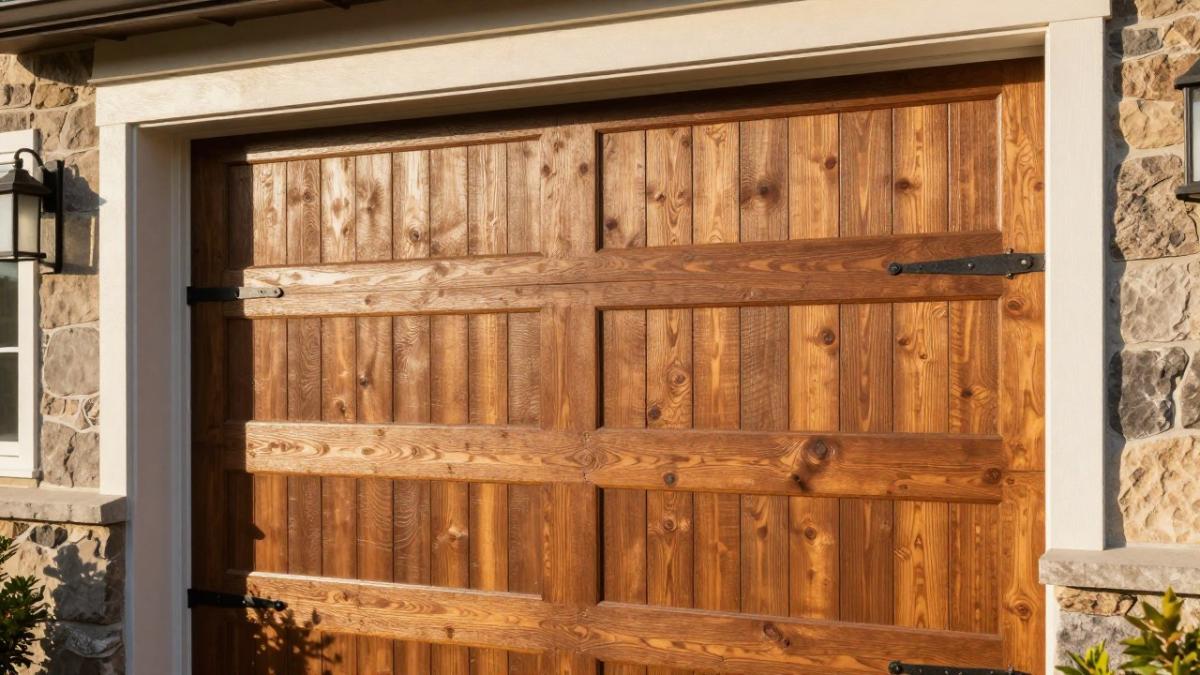
That matters more than most homeowners realize. The garage door typically occupies a large share of the front elevation, so it sets the tone for everything around it. A handcrafted wooden garage door brings warmth, depth, and a distinctive appearance that flat materials cannot copy. Wood grain shifts with the light. Artisanal detail shows at the edges and rails. The result is curb appeal that looks earned, not manufactured.
Below, we break down the benefits, the trade-offs, the species and finish choices, and a general maintenance approach for wood doors. But first, here is what most buying guides get wrong: they treat wood as a purely aesthetic choice. It is also a structural and financial one.
Handcrafted Wooden Garage Door Benefits Pros and Cons
The benefits are real, and so are the costs. Here is the balanced version.
The pros:
- Unmatched warmth and distinctive appearance that no steel or aluminum door replicates
- Deep customization of size, panel style, finish, and hardware
- Solid construction with genuine structural strength and repairability
- Natural sound absorption that softens street noise
- Strong resale signal, since a wood carriage door reads as a premium upgrade
The cons:
- Higher upfront cost than a stock steel door
- Real maintenance: cleaning, sealing, and periodic refinishing
- Vulnerability to moisture, sun damage, and warping if neglected
- Heavier door weight that demands correct hardware and professional installation
None of these cons are dealbreakers. They are simply the price of owning something built rather than bought off a shelf. The homeowners who regret a wood door are almost always the ones who skipped the maintenance schedule, not the ones who chose wood.
Here is the balanced version of what a handcrafted wooden garage door gives you and what it asks of you.
| Aspect | Pros | Cons |
|---|---|---|
| Appearance | Unmatched warmth and distinctive appearance | None stated |
| Customization | Deep customization of size, panel style, finish, hardware | None stated |
| Construction | Solid construction with structural strength and repairability | Heavier door weight demands correct hardware and pro installation |
| Sound | Natural sound absorption softens street noise | None stated |
| Resale | Strong resale signal as a premium upgrade | None stated |
| Cost | None stated | Higher upfront cost than a stock steel door |
| Upkeep | None stated | Real maintenance: cleaning, sealing, periodic refinishing |
| Exposure | None stated | Vulnerability to moisture, sun damage, warping if neglected |
Wood Species, Craftsmanship, and Custom Design Options
Species selection drives everything downstream: appearance, weight, weather behavior, and how the finish takes.
Craftsmanship is where handcrafted doors separate from factory lines. The panel style, window configuration, arch, and strap hinges all get decided at this stage, which is why the design conversation matters as much as the wood itself.
If you want to see how these finishes read on a real home before committing, browse custom stained wood carriage house garage doors or explore custom painted wood carriage house garage doors. Both galleries show the species, panel styles, and hardware combinations we build most often.
Durability, Weather Resistance, and Insulation Performance
A well-built wood door is durable, but durability is not a single property. It is the product of species, grain orientation, joinery, finish system, and installation detail. Get those right and a wood door can hold up well over time. Get them wrong and it can fail much sooner. Here is how the mechanisms actually work.
Moisture is the primary enemy, and end grain is the entry point. Wood moves as it gains and loses moisture, swelling across the grain and shrinking as it dries. End grain, the cut ends of stiles, rails, and panels, wicks water far faster than face grain, which is why every end cut on a quality door is sealed before assembly. The failure chain is predictable: water enters an unsealed end or a failed bottom seal, the wood swells, the finish cracks at the joint, more water enters, and rot begins in the shadowed bottom rail where air circulation is poorest.
Sun exposure is the second enemy, and it attacks the finish before the wood. Ultraviolet light breaks down the lignin at the surface and degrades the clear coat or stain film. Once the film fails, the surface dries and checks, and the grain opens. A darker stain absorbs more heat and can accelerate finish breakdown on a south- or west-facing door, while a lighter or painted finish runs cooler. The practical rule most finishers follow is to inspect the sun-facing side first and refinish it sooner than the shaded side.
Climate changes which species and finish make sense. In humid climates, wood gains moisture seasonally and the priority is ventilation behind the door, sealed end grain, and a finish that lets the wood breathe rather than trapping moisture. In coastal exposure, airborne salt accelerates hardware corrosion and finish degradation, so stainless or hot-dipped galvanized hardware and more frequent rinsing matter as much as the wood itself. In freeze-thaw climates, water that enters a joint and freezes expands and pries the joint apart, which makes the bottom seal and flashing details critical. In intense-sun climates, UV-stable finishes and lighter tones extend service life.
Insulation performance depends on construction, not on the word “wood.” A solid-wood door provides moderate thermal resistance through the wood itself, but the bigger variables are the core, the backer, and the air sealing. A door built with an insulated core and a sealed perimeter performs very differently from a hollow or uninsulated door of the same face. R-value figures quoted for garage doors are typically whole-door assembly values that include the core and frame, not the face material alone, so compare like for like and ask what the number covers.
Watch out: a wood door installed without a proper bottom seal, sealed end grain, and correct flashing will take on water during heavy rain, and that is where rot starts. Installation is not a detail here; it is the warranty.
Hardware and weight are part of durability. A handcrafted wood door is heavier than a comparable steel door, which puts more load on tracks, hinges, rollers, and springs. Springs are sized to the door’s weight, so a door that is re-skinned, re-glazed, or fitted with heavier hardware needs its spring system re-evaluated.
Handcrafted Wooden Garage Door Benefits Cost: What Drives the Price
Pricing depends on several variables, so treat any single number you see online with suspicion. What a buyer can do is understand the drivers, the realistic ranges, and the lifecycle math that separates a cheap door from a good value. Here is the honest version.
The main cost drivers:
- Species, premium hardwoods such as mahogany cost more than cedar or Douglas fir, both in material and in the finishing time they require.
- Size and configuration, double doors and arched openings require more material, more joinery, and more labor than a single rectangular door.
- Panel style and detailing, custom carvings, true divided lites, and hand-forged hardware add fabrication time.
- Finish, multi-step stains and painted finishes take longer than a clear seal, and a hand-rubbed finish takes longer still.
- Installation complexity, opening condition, header requirements, track and spring sizing, and hardware all factor in.
Realistic ranges.
The lifecycle comparison competitors skip. The purchase price is only the first line. Over a twenty-year horizon, the meaningful comparison is purchase plus installation plus maintenance plus repair plus replacement, discounted for how long each door actually lasts.
The right answer depends on how long you plan to own the home and how much maintenance you are willing to schedule.
Resale is the other half of the math. According to the Cost vs. Value Report, an upscale garage door replacement has ranked among the highest-return remodeling projects studied, which tracks with what we see in the field: buyers notice the door. For the full breakdown, see our analysis of upscale garage door ROI.
Pricing depends on design, materials, and installation conditions. Contact Image Doors through our website for current pricing or a quote.
Wood Garage Door Maintenance: A Practical Schedule
Wood garage door maintenance is simple but non-negotiable. A light routine keeps the finish intact and prevents the expensive problems.
Wood Garage Door Lifespan and Long-Term Value
Resale value is the other half of the equation. According to the Cost vs. Value Report, an upscale garage door replacement has ranked among the highest-return remodeling projects studied, which tracks with what we see in the field: buyers notice the door. For the full breakdown, see our analysis of upscale garage door ROI.
Designing Your Carriage House Door with Image Doors
The right door starts with the house. We work with homeowners, builders, and architects to design custom carriage house doors and deliver professional installation. One repeat client put it plainly: “This is the second time we used Image Doors on our projects. Very professional, on schedule and installation was very professional.”
If you are ready to order, check custom garage door lead times so your remodel schedule holds. When you want to talk through species, style, and finish, contact us for a free estimate.
The difference between a wood door that looks stunning in year fifteen and one that looks tired in year three is almost never the wood itself. It is the species choice, the build quality, and the installation behind it. Image Doors has 18 years of industry experience as an exclusive distributor of authentic carriage house doors, offering meticulous handcrafting, custom design options for any application, and professional installation. Get started with Image Doors and give your home the entrance it has been missing.
Frequently Asked Questions
What are the downsides of handcrafted wooden garage doors?
The main downsides are higher upfront cost, more frequent upkeep than steel or aluminum, and vulnerability to moisture if the finish is neglected. Wood can warp, rot, or fade when exposed to sun and rain without proper sealing. However, with a regular maintenance schedule and quality protective coating, these issues are manageable. Homeowners who want a distinctive appearance and are willing to invest in care often find the trade-off worthwhile.
How long do wooden garage doors last?
Lifespan depends on how well a wood garage door is maintained and on the conditions it faces. Lifespan depends on wood species, climate, and how consistently you clean, sand, and reseal the surface. In hot, humid, or coastal climates, more frequent inspections help catch moisture damage early. Proper installation also plays a role in structural strength and long-term performance.
Are handcrafted wooden garage doors energy efficient?
Wood naturally offers some insulation, and the door’s thickness, panel construction, and seal quality all affect performance. The door’s thickness, panel construction, and seal quality matter more than the material alone. If your garage is attached to living space, adding insulation and proper weather protection helps reduce operating costs and sound transfer. Ask your installer about insulation options for your project.
Can a wooden garage door be customized to match a home’s style?
Yes. Handcrafted wooden doors are among the most customizable options available. Custom design options are available for any application, so the door can be matched to the home’s architectural style, including carriage house styles. Working with a specialist ensures the final door complements the home’s warmth and character.

Recent Comments