
Table of Contents
- What Drives Custom Garage Door Lead Times in 2026
- Typical Lead Time Ranges by Material and Door Type
- Factors Affecting Garage Door Manufacturing Time
- The Custom Garage Door Installation Timeline, Step by Step
- How to Prepare for Custom Garage Door Installation
- Contingency Planning: What to Do When Lead Times Slip
- Conclusion
- Frequently Asked Questions
Last Updated: September 18, 2026
What Drives Custom Garage Door Lead Times in 2026
Custom garage door lead times for custom projects typically run 6 to 16 weeks from quote acceptance to final installation, depending on material, finish, and how quickly you approve the design. The clock does not start when you sign the quote. It starts when the factory has a locked drawing and a confirmed finish.
Typical Lead Time Ranges by Material and Door Type
Material choice is the largest single variable in total lead time. A steel door and a handcrafted wood carriage house door can differ by two months or more, even when the sizes are identical. What most published ranges hide is that each material has its own bottleneck: steel is limited by the production queue, aluminum by glass and finish sourcing, wood by milling and hand-finishing, and full-custom specialty builds by the approval loop and cure time.
| Material / Door Type | Design & Approval | Fabrication | Total Typical Range | Primary Bottleneck |
|---|---|---|---|---|
| Steel sectional | 1-2 weeks | 3-5 weeks | 4-7 weeks | Production queue depth |
| Aluminum with glass | 1-2 weeks | 4-6 weeks | 5-8 weeks | Glass and finish sourcing |
| Wood carriage house | 2-4 weeks | 6-12 weeks | 8-16 weeks | Milling and hand-finishing |
| Custom specialty finish | 2-4 weeks | 8-14 weeks | 10-18 weeks | Approval loop and cure time |
Wood and Carriage House Doors
Wood carriage house doors sit at the long end because each door is built to order. Kiln-dried lumber, joinery, and hand-finishing cannot be compressed without cutting corners. Specialty paint and custom stain add another step, since finishes often cure between coats. Species selection matters too: a domestic species like cedar or mahogany is usually stocked by regional mills, while an exotic species may need to be sourced and can add one to three weeks on its own.
Steel and Aluminum Doors
Steel and aluminum move faster because panels and hardware come from standing production lines. The variables that slow them down are non-standard sizes, custom colors, and window configurations, all of which pull the door out of the standard queue. Aluminum with glass is the most sensitive to glass sourcing: insulated or tempered units are often made by a separate supplier, so a glass backorder can stall an otherwise finished door.
How to Use These Ranges Without Getting Burned
A range is only useful if you know which end you are likely to land on. Three questions move you from the optimistic end to the realistic end:
- Is my size standard or non-standard? Non-standard dimensions push the door out of the standing queue.
- Is my finish a stock color or a custom match? Custom matches add a sample-approval cycle and cure time.
- Is any component imported or specialty-sourced? Hardware, glass, and exotic lumber each carry their own procurement clock.
Material sets the floor for your timeline. Everything else, approval speed, finish complexity, and installation scheduling, either adds to that floor or leaves it intact. The bottleneck column above tells you where to focus your questions.
Factors Affecting Garage Door Manufacturing Time
Manufacturing time is governed by the production queue, material sourcing, and door specifications, not by how urgently you need the door. A factory builds in sequence, and a custom size or finish moves your order into a different, often slower, lane.
The biggest levers on manufacturing time:
- Production queue depth. Peak building season lengthens every queue, regardless of material.
- Material sourcing. Imported hardware, specialty glass, and certain wood species carry their own procurement timelines.
- Custom size and door specifications. Non-standard dimensions require unique fabrication setups.
- Insulation type and hardware availability. Specific insulation and hardware combinations can trigger a backorder.
- Specialty finish. Powder coating and custom paint add curing and inspection steps.
The Approval Bottleneck That Adds Weeks
The most common cause of a delayed custom garage door is not the factory. It is the approval loop. Every revision to a drawing, finish sample, or hardware selection restarts part of the process, and each round trip can cost several days.
Requesting a design change after the drawing is approved can push your door to the back of the production queue. Confirm every dimension, finish, and hardware choice before you sign off.
The Custom Garage Door Installation Timeline, Step by Step
The custom garage door installation timeline runs in a fixed sequence, and each step depends on the one before it. Understanding the order lets you anticipate where delays appear and plan around them.
- Consultation and measurement. A site visit confirms rough opening dimensions, headroom, and structural conditions.
- Design and drawing. You receive a drawing reflecting size, panel style, window layout, and finish.
- Quote acceptance. Approving the quote locks specifications and starts the production clock.
- Material sourcing. The factory pulls lumber, steel, hardware, and finish materials for your build.
- Fabrication. The door is built, finished, and inspected.
- Shipping and delivery. The finished door ships to the installer and is staged for the install date.
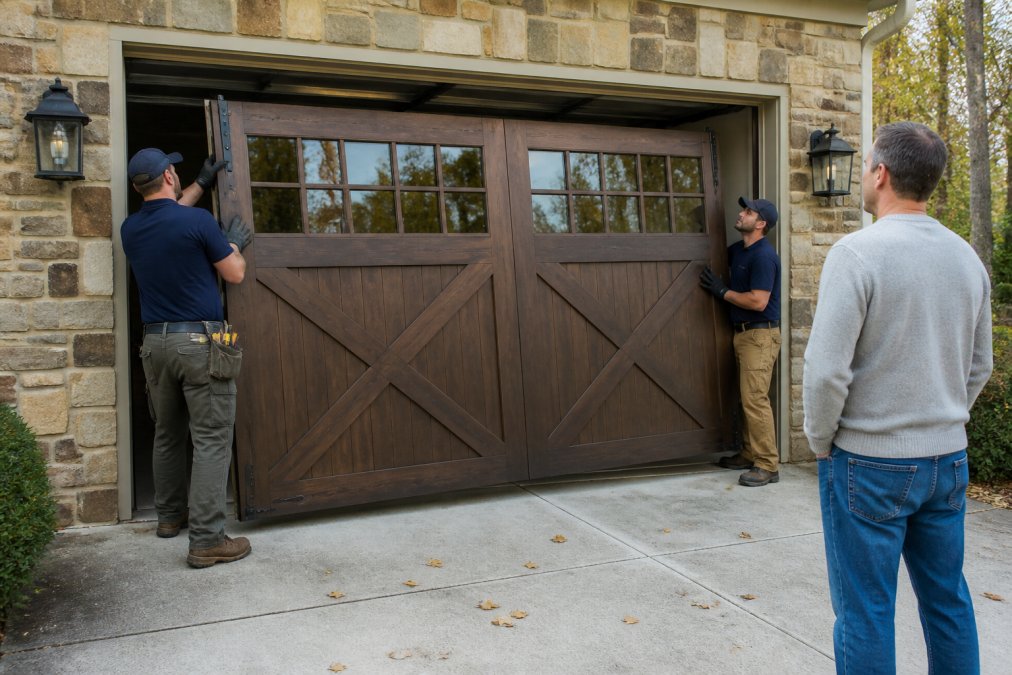
- Installation. The crew sets the door, tracks, springs, and hardware, then tests operation.
How to Track Your Order Through Production and Shipping
Order tracking on a custom door is a conversation, not a webpage. Ask your provider for milestone updates: drawing approval, production start, finish complete, ship date, and delivery confirmation. Contractors who request these checkpoints catch a slipping delivery schedule before it disrupts the installation window.
How to Prepare for Custom Garage Door Installation
Preparation determines whether installation day runs smoothly or stalls. A cleared, accessible garage and confirmed measurements prevent the most common on-site delays.
How to prepare for custom garage door installation:
- Clear the garage interior and driveway of vehicles and stored items.
- Confirm the rough opening dimensions match the approved drawing.
- Verify electrical outlets and lighting near the opening are functional.
- Remove fragile items from walls adjacent to the tracks and springs.
- Confirm the installation window with your contractor at least a week ahead.
Contingency Planning: What to Do When Lead Times Slip
Lead time variance is normal, not exceptional. Supply chain disruption, backordered hardware, and a crowded production queue can each add days or weeks, so build a buffer into your project schedule rather than assuming the best case. What most guides skip is what to actually do when the slip happens. Below is a decision framework, not just a list of good intentions.
Build the Buffer Before You Need It
- Add a two-to-three week buffer to your target completion date.
- Lock the design early to remove the approval bottleneck.
- Ask about hardware availability before finalizing specifications.
- Confirm the installation window as soon as the ship date is known.
- Keep contractor communication open with a single point of contact.
The Plan B Decision Tree
When you learn the door will be late, the right response depends on how late and what is driving the delay:
- One to two weeks late, fabrication on track. Hold the install date if the site can absorb the slip. Notify the contractor and any other trades scheduled around the install.
- Two to four weeks late, material backorder. Ask whether an equivalent in-stock component (hardware, glass unit, finish) can be substituted without changing the approved drawing. Substitutions that do not alter dimensions or finish usually do not restart the queue.
- Four or more weeks late, or the queue itself has slipped. Ask for a revised ship date in writing and re-sequence the project. If the door is on the critical path for a closing or listing, discuss a temporary door or a delayed-installation agreement rather than holding the whole project.
A Communication Template for Contractors
Subject: [Project address], custom door status and revised ship date
Hi [name], checking in on order #[number]. Can you confirm: (1) current production stage, (2) any component on backorder, (3) best-case and worst-case ship dates, and (4) whether any substitution would avoid a delay without changing the approved drawing? I need to re-sequence the install and other trades, so a written update by [date] would help.
Geographic Supply Chain Variance
Where your door’s parts originate affects how fast a recovery is possible. A door assembled from regionally sourced materials may move faster than one dependent on imported components, because a regional supplier can often expedite a replacement while an overseas shipment cannot. Ask where your door’s parts originate at the quote stage, and ask which components are single-sourced. Single-sourced components are the ones most likely to cause an unrecoverable delay.
If your project has a fixed deadline, such as a listing date or a builder’s closing schedule, tell your provider at the quote stage. It changes how the order is sequenced and gives you a realistic delivery schedule instead of a hopeful one. Then confirm the buffer in writing before you sign.
Do not wait until the original ship date passes to ask about status. A check-in at the midpoint of fabrication gives you time to substitute a component or re-sequence trades. A check-in the week of delivery gives you almost no options.
Conclusion
Custom garage door lead times reward preparation and punish indecision. The projects that finish on schedule share one trait: specifications locked early and a buffer built into the calendar, not squeezed out of it.
Frequently Asked Questions
How long does it take to get a custom garage door made?
Most custom garage doors take 6 to 16 weeks from order to delivery, depending on material and complexity. Wood and carriage house doors typically run 10 to 16 weeks because of handcrafting and finishing, while steel and aluminum doors usually arrive in 6 to 10 weeks. Add 1 to 3 weeks for installation scheduling. Custom garage door lead times also stretch during peak spring and summer building seasons.
What factors cause delays in custom garage door lead times?
The biggest causes are slow design approval, specialty finish backlogs like powder coating or custom paint, and hardware availability. Supply chain disruption for imported springs, tracks, and rollers can add weeks. Production queues at the manufacturer also matter: a door ordered during a busy period waits longer. Locking in your design approval early is the single most effective way to avoid these delays.
Do material choices affect the delivery time of a custom garage door?
Yes. Wood doors require milling, assembly, and a multi-step finish that adds weeks. Steel doors move faster because they use standardized panels, but custom sizes and colors still add time. Aluminum doors with glass sections fall in between. Insulation type also plays a role: polyurethane insulation takes longer to source than polystyrene, especially for non-standard door specifications.
How can I prepare for my garage door installation during long lead times?
Order early and confirm your design in writing before the deposit. Clear the garage and driveway, verify the opening dimensions, and check that your electrical outlet for the opener is in place. If you are working with a builder, share the delivery schedule with your general contractor so framing and painting are sequenced around it. Ask about order tracking so you know when the door ships.
Recent Comments